
Author Archives: Alpha Parking
City and Guilds training advertisement
Check out our training advertisement in the Parking Review October and November issue:
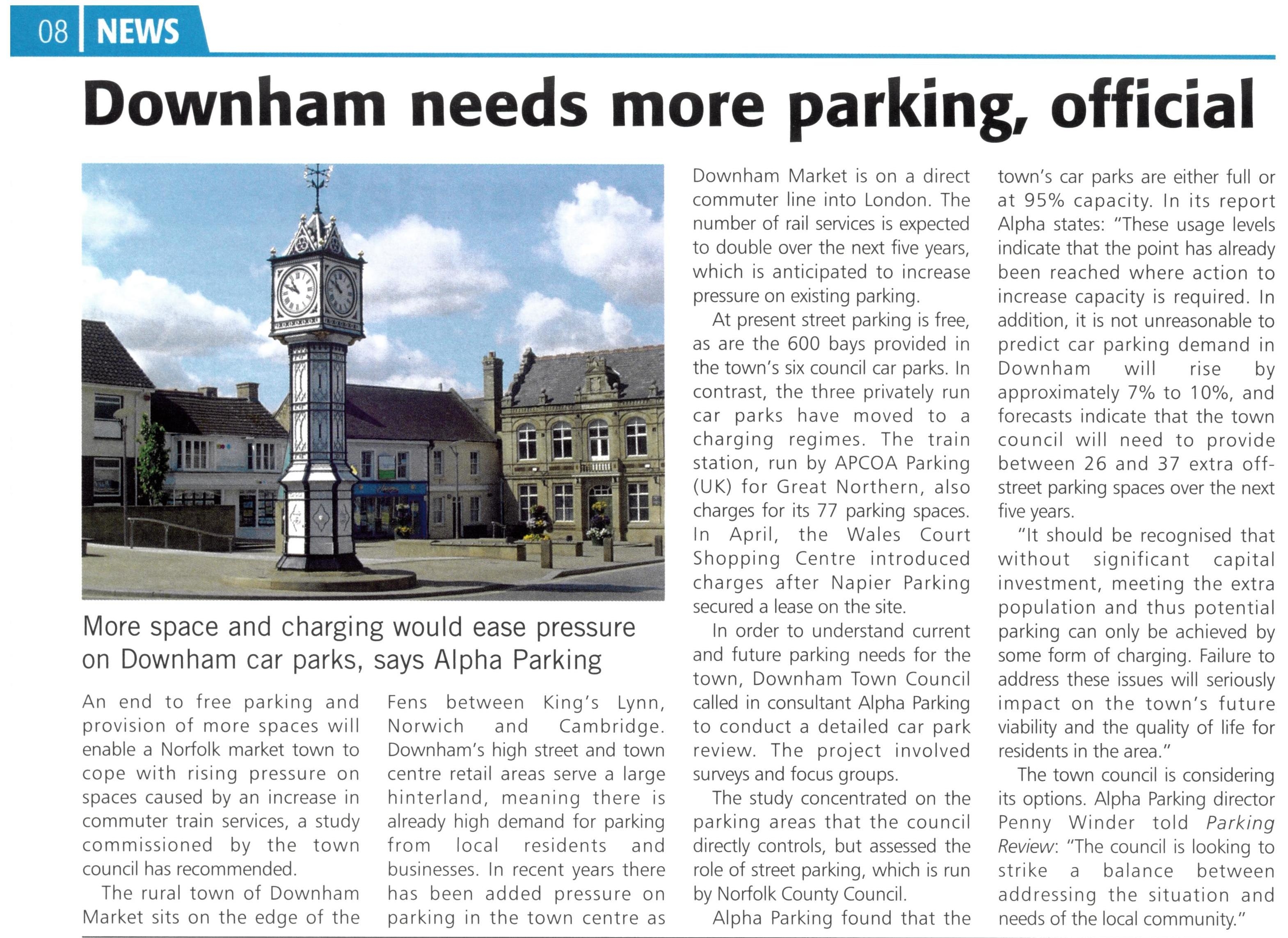
Downham Market needs more parking
Parking Review Issue 282 | October 2015
Parking Team Leaders and Supervisors
INFORMATION FLYER
Spotlight on Parking 2015
Thank you to all of the speakers and guests who attended Spotlight on Parking 2015.
“An Overview of How Bay Sensor Technology Drives Efficiency, Increases Revenues & Creates a Positive Customer Experience”
Kieran Fitsall, Head of Service Improvement & Transformation, Westminster City Council
Click here to view the presentation
“Future Trends in Driving”
Dr Ivo Wengraf, Research & Data Manager, RAC Foundation
Click here to view the presentation
“Adjudicating the Future”
Caroline Sheppard, Chief Adjudicator, The Traffic Penalty Tribunal
“The Surveillance Camera Code of Practice – What it means for Parking Enforcement”
Tony Porter, The Surveillance Camera Commissioner
Steve Hewitt talks about City and Guilds partnership and Spotlight event
Private Parking Qualifications
Failure to address Downham Market’s parking problems will affect ‘viability’
Downham will need nearly 40 extra parking spaces within the next five years, according to a traffic survey.
Inspectors from Alpha Parking have warned that failing to address the parking problems in Downham will affect the town’s future. The team has also advised that some form of charging can only achieve the investment needed to meet the demand.
Downham Town Council called in the firm to review of the town’s car parks last year after receiving complaints about spaces being blocked.
The report states that the town’s car parks are either full or at 95 per cent capacity.
It states: “These usage levels indicate that the point has already been reached where action to increase capacity is required. “In addition, it is not unreasonable to predict car parking demand in Downham will rise by approximately seven per cent to 10 per cent and forecasts indicate that the town council will need to provide between 26 and 37 extra off-street parking spaces over the next five years. “It should be recognised that without significant capital investment, meeting the extra population and thus potential parking can only be achieved by some form of charging.
“It should be recognised that failure to address these issues will seriously impact on the town’s future viability and the quality of life for residents in the area. The report is due to be discussed at Thursday’s annual meeting in the town hall at 7pm. Mayor John Doyle says no decision has been made with regards to the car parks He said: “We have had people park in the town for three weeks and go on holiday.
“Car parking is controversial at the moment. It seems at times the car parks are clogged up and my personal opinion is that we have got to do something about the log jam. “This is just a strategy. Before anything is done we would need a public meeting.”
Don’t let your CEOs’ performance be a mystery
To truly understand what challenges your CEOs face in their day-to-day lives, get “streetwise” by learning from the retail industry.
Make no mistake, it’s tough on the streets and the working life of a CEO is far from easy. This much maligned role (at least by the general public) is about much more than simply issuing parking tickets, especially since the introduction of the Traffic Management Act.
CEOs act as the “eyes and ears” of a council on the streets, and in addition to firmly but fairly enforcing parking regulations, as we know, their duties have been expanded. Nowadays, these might include inspecting blues badges, reporting inaccurate or missing signs and lines, reporting suspicious activity and helping to deter car crime.
Aside from their growing responsibilities, dealing with verbal and even physical abuse is now sadly a daily occurrence.
As CEOs are expected to continue performing this crucial role for councils, it is vital their employers offer them the necessary support and training for what is among the toughest local authority jobs.
But how can you measure how well your parking enforcement policy is being implemented across your local authority’s catchment area, where there are any gaps in enforcement, and where extra training may be needed?
There is a measurement tool that can be used which people may be more familiar with in the context of retail stores.
Independent ‘mystery shopping’ studies which are a great way of gauging parking team performance.
Mystery Shopping is a technique which monitors CEOs and Notice Processing Staff in their working environment and if used correctly can effectively ascertain how they interact with the public, how efficiently they carry out their role and their knowledge of the parking services as a whole.
There are a number of ways that the technique can prove invaluable. One London Borough Council wanted to understand why the number of penalty charge notices had dropped under its new enforcement contract.
A number of existing parking “beats” were selected for the study to establish a snap-shot of data, parking compliance and PCN activity within the borough.
Beats were chosen to be as representative of the borough as possible and were patrolled by experienced staff who held the City & Guilds level 2 CEO qualification.
Each street within each beat was patrolled by the mystery shopper as though they were an active CEO carrying out parking enforcement duties, recording all the same data.
The information gathered was cross referenced with the council’s PCN data for the real CEOs who were patrolling at the same time.
The results showed that although there was a high degree of compliance to parking restrictions throughout the borough, there were some inconsistencies in enforcing the parking protocol. Through the use of Mystery Shopping these inconsistencies were identified and remedied.
In another example, a council in North East England employed Mystery Shopping to measure the local council’s overall parking performance.
The mystery shopper team posed as members of the public, interacting with CEOs within a designated patrol beat. In this instance, Mystery Shopping should not be used to ‘entrap’ individual CEOs but rather to monitor and assess their performance.
They also made a series of phone calls, apparently as members of the public, to the parking services department.
The task included shadowing CEOs within a designated ‘beat’, and a team was deployed to different areas of the city to work out how many PCNs they would issue to vehicles believed to be contravening parking regulations.
The team also conducted an in-depth review of the main procedures carried out by the notice processing department.
The resulting data collected was used to provide constructive advice and recommendations on how the service could be improved and where training was needed.
This has the added benefit of providing data for Annual Reports and a benchmark for similar exercises in the future.
So mystery shopping can achieve a lot more than simply measuring how good the customer service is at your local retail stores!
A guide to choose the right survey
Choose your survey…
This is a guide designed to help you choose the right survey for your needs
Parking stress surveys
A detailed knowledge of things, such as times of usage and areas where occupancy levels are above average, are factors that can influence and change parking patterns. This information helps architects, surveyors and developers to project manage a development cost-effectively. A ‘parking stress survey’ involves planning and carrying out the survey and then producing reports, maps and photographs to meet the clients’ requirements.
Parking stress reflects the number of parked vehicles as a percentage of the amount of authorised available parking. The parking stress survey highlights any potential areas of concern and gives detailed feedback on the current situation on the street.
An additional feature of a parking stress survey is that it can assess compliance with the Traffic Signs Regulations and General Directions 2002 (TSRGD), a piece of legislation that regulates the placement and quality of signs and lines on the roads.
Occupancy and duration surveys
These surveys are important as they help operators determine when car parks are at their busiest and when demand for space is low. Information gleaned from these surveys includes: how long people park for; what sections of the population use a car park; and local parking habits.
Asset and condition surveys
Making sure that signs and lines are in the correct place and give accurate information is crucial for both local authorities and developers. An ‘asset survey’ will record the location, fixing and condition of traffic signs, lines and street furniture and make sure that they are complying with the TSRGD. A ‘condition survey’ will assess local parking signs and lines to ensure that they are in a good condition and compliant with the legislation that governs signage on the roads.
Inventory surveys
When private car park operators and local authorities are assessing the usage and demand for parking, they need basic information such as number and type of parking spaces available. For example, a local authority might need to prove it is already providing enough Blue Badge spaces while a supermarket might want to advertise its parent & child parking. An ‘inventory survey’ will provide a full picture on parking at a specific locale,
providing information needed to understand the relationship between provision and demand.
Feasibility studies
A feasibility study will look at factors such as the current cost of parking, the demand for parking, seasonal or daily variations in demand, and trends that could impact on parking in the future. For example, if a car park currently charges 50p to park for two hours and the operator feels it is unlikely to change in the near future there is then no reason to upgrade its parking equipment to accept credit cards as investment outweighs